The hazelnut's journey through processing: from purchase to paste
Drying, cracking, sizing, roasting, chopping and milling: what happens to a hazelnut between orchard and finished ingredient, and why each step matters.
A pastry chef opening a sack of roasted chopped hazelnuts sees even pieces, a golden colour and an aroma reminiscent of caramel. To reach that point, the nut goes through a series of steps in which every mistake later shows up in the product: too much moisture means mould, poor sizing means uneven roasting, and overheating during milling means a bitter paste.
For us, processing begins with buying Croatian hazelnuts from local growers and ends with a finished ingredient. Below we describe that journey in the order it happens and explain why each step matters to the people who buy hazelnuts.
Purchasing and intake
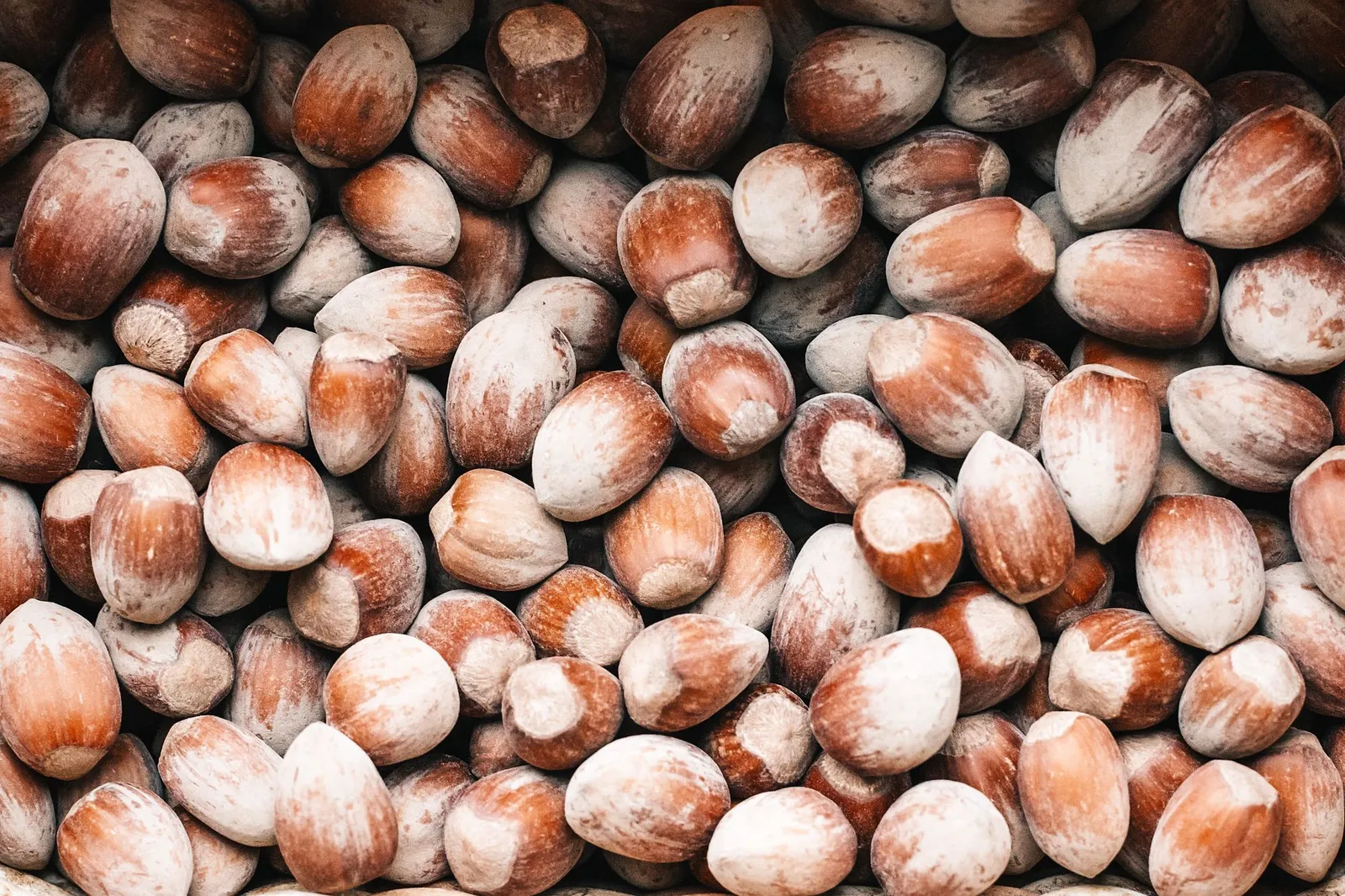
Hazelnuts are harvested in late summer and early autumn, when the nuts drop from the bush of their own accord. Growers collect them from the ground, so the first lot arrives with leaves, twigs, soil and empty nuts. That is why intake is more than weighing: moisture, the share of foreign matter and kernel quality are checked on a sample that is cracked and inspected.
We buy hazelnuts all year round, not only in season, so growers who have dried and stored their crop well do not have to sell straight after harvest. The terms are set out on the page for growers.
Drying: the foundation of shelf life
Freshly harvested hazelnuts contain too much moisture for storage. If they are not dried, they heat up in the pile, mould develops and the kernel takes on a musty smell that not even roasting can remove later. They are dried with warm air or naturally, in a thin layer with ventilation, until moisture falls to a level suitable for storage; the trade typically expects kernel moisture below roughly 6–7%.
Drying must not be rushed with excessive heat. A shell dried too quickly can crack, and the kernel can lose some of its aroma before anyone has roasted it.
Sizing, cracking and shell separation
Before cracking, in-shell hazelnuts are graded by size. The reason is practical: the cracker is set to a gap that suits one nut size. If small and large nuts are in the same lot, the small ones pass through uncracked and the large ones are crushed together with the kernel.
After cracking, the shell is separated from the kernel, usually by an air stream, since the shell is lighter. Kernel sorting follows: damaged, shrivelled and discoloured kernels and those showing signs of pests are removed. This is a step the buyer never sees but tastes in every sack, because a single rancid or mouldy kernel can spoil the flavour of an entire batch of cream.
The kernels are then sized again. Uniform kernels matter for everything that follows, and for roasting in particular.
Roasting and blanching
Roasting drives off the remaining moisture, makes the hazelnut crunchy and develops the aroma we recognise in creams and chocolate. At the same time the thin brown skin around the kernel loosens and is then removed by rubbing and an air stream. The result is a clean, skinless kernel of the kind we want for pastes and fine creams.
The degree of roast is set according to the end use: lighter for a mild, milky flavour, darker for a pronounced aroma. Straight after roasting the kernels must be cooled quickly, because retained heat carries the process on and the nuts end up darker than planned. Blanched kernels are intended for recipes in which the skin gets in the way, whether because of its colour or its slight bitterness.
Uniform kernel size is not about looks but a precondition: only nuts of the same size roast the same way.
Chopping and sieving
The roasted kernels are cut into pieces and then sieved into fractions. A 2–4 mm grade means the pieces passed through a 4 mm sieve and were retained on a 2 mm one. Sieving is what separates chopped hazelnuts for professional use from nuts that have merely been broken up: the sack contains no dust that would burn in a topping and no oversized pieces that would break through a thin crust. The fractions also behave differently: small pieces absorb fat and moisture from their surroundings faster, and darken faster in the oven than large ones.
We supply roasted chopped hazelnuts in 0–2 mm, 2–4 mm and +4 mm granulations, and if you need a different fraction, just ask: we will produce it.
Milling into paste
To make paste, roasted kernels are milled until the cells break down and release their oil, so the dry mass turns into a thick, flowing paste. A 100% paste contains no added sugar, oil or emulsifiers: its only ingredient is hazelnuts. The fineness of the grind determines the mouthfeel, and the temperature during milling determines the flavour; if the mass overheats, the roasted aroma turns bitter.
In hazelnut paste some of the oil gradually separates to the surface. This is natural in a product without additives and does not mean the paste has gone off; simply stir it thoroughly before use.
What this means for the buyer
Every processing step can be adjusted: the degree of roast, the granulation, the fineness of the paste. When you write a specification, state what the product is for, not just the name of the raw material, because the same hazelnut used as a croissant topping and as a praline filling need not be roasted to the same degree or cut to the same size. If you need hazelnuts processed to your own recipe, or your own raw material processed, take a look at our toll processing.
We only use necessary cookies that the shop needs to work. Cookie policy
We only use necessary cookies and browser storage, without which the shop does not work: your basket, login, the chosen language and remembering this notice. We do not use analytics or marketing cookies. Cookie policy