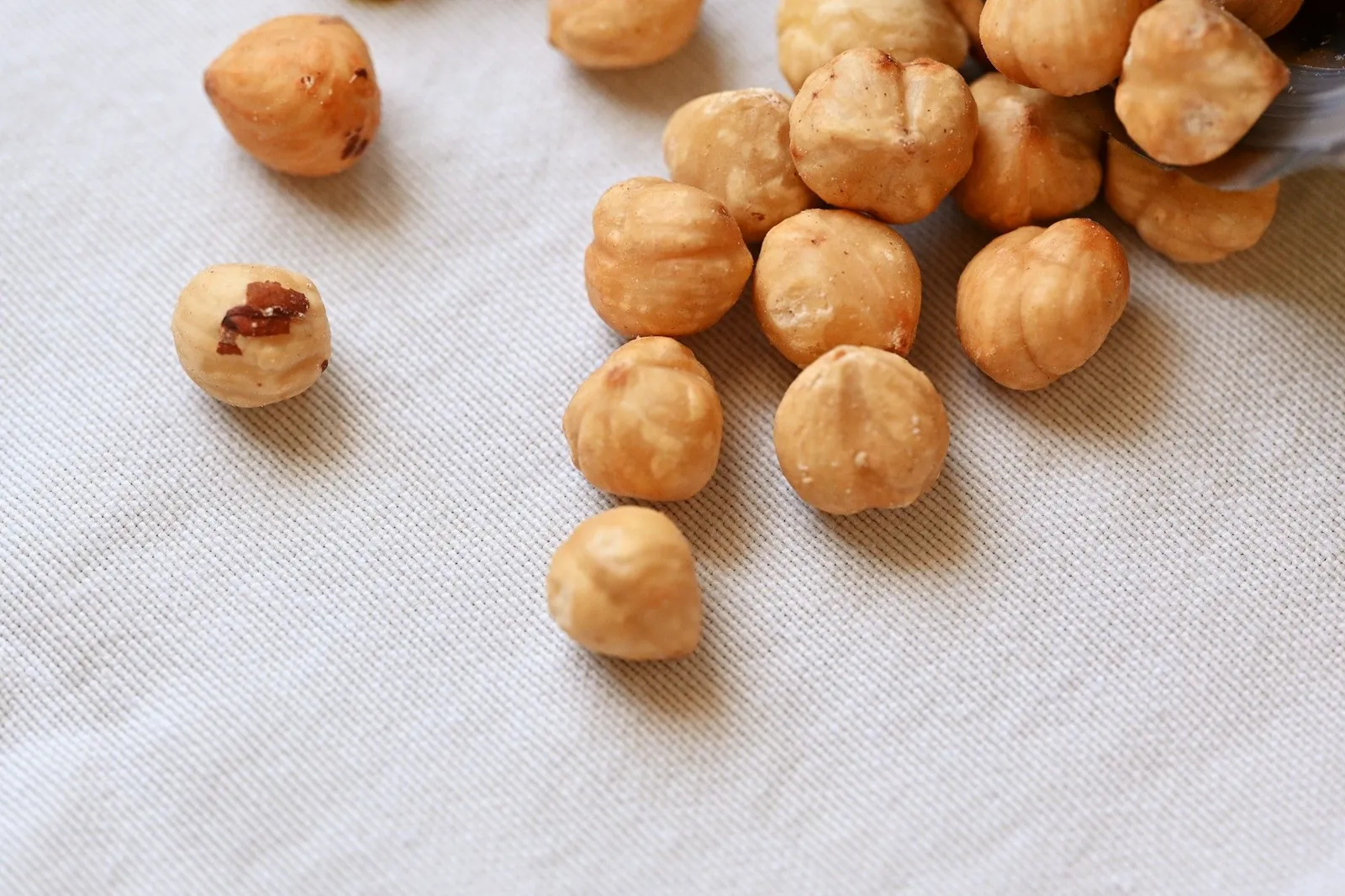
Raw hazelnuts have a mild, almost milky flavour and a soft bite. Only roasting gives them the aroma we recognise in creams, chocolate and ice cream. For a pastry chef or food technologist, the question is not whether to roast hazelnuts but how far, because the degree of roast determines the flavour, the colour and how the nut behaves in the finished product.
In this guide we explain what happens inside the kernel during roasting, how light, medium and dark roasts differ, and which mistakes come up again and again in practice.
Under the influence of heat, several processes take place in the kernel at the same time:
- Loss of moisture. The remaining water evaporates, so the kernel becomes lighter, brittle and crunchy. This is exactly why roasted hazelnuts readily pick up moisture from the air and turn soft if left open.
- Maillard reactions. Sugars and amino acids in the kernel react, creating hundreds of aroma compounds and a brown colour. It is the same type of reaction that gives bread its crust and roasted coffee its aroma.
- Changes in the oil. Heat breaks down some of the cells, the oil is released more easily and the kernel takes on a sheen. Roasted hazelnuts are therefore easier to mill into paste, but also more prone to oxidation than raw ones.
- Skin release. The thin brown skin dries and cracks, so after roasting it can be removed by rubbing and an air stream.
The easiest way to judge the degree of roast is from the cross-section: cut a hazelnut in half and look at the colour inside, not just on the surface. In practice, hazelnuts are roasted with hot air, roughly in the range of 140 to 170 °C for about ten to twenty minutes, depending on the equipment, the kernel size and the result you are after.
| Degree | Cross-section colour | Flavour | Typical use |
|---|
| Light | cream to pale gold | mild, sweet, milky | pastes for milk-based creams and ice cream, products that will be baked again |
| Medium | golden to light brown | distinct hazelnut, hint of caramel | pralines, chopped hazelnuts for toppings, all-round use |
| Dark | brown | intense, roasted, slight bitterness | pairings with dark chocolate, coffee and caramel |
The bitterness of a dark roast is not necessarily a flaw. With dark chocolate and coffee it adds depth, but in a milk cream or ice cream it can easily drown out the more delicate notes.
The skin carries an astringent, slightly bitter taste and dark specks. In a paste for a pale cream or in white chocolate those specks are visible and the bitterness comes through, so skinned hazelnuts are used for such applications. In rustic breads, granola or cakes with a dark crumb the skin does no harm, and some bakers even ask for it because of the look.
Bear in mind that the skin never comes off one hundred per cent. The share of residual skin varies between harvests and varieties, so if it matters to you, state it in your specification. For recipes in which the skin gets in the way but the nut must not be darkly roasted, there are also blanched kernels.
You do not need a laboratory to check a delivery. Take a handful of kernels from the middle of the sack, not from the top, and check the following in turn:
- Cross-section colour. Cut a dozen kernels in half. The inside should be evenly coloured and match the agreed degree of roast; dark edges around a pale centre point to roasting too fast at too high a temperature.
- Snap. A well-roasted kernel breaks cleanly and crisply. If it bends or is chewy, it has absorbed moisture.
- Smell and taste. The smell should be warm and nutty. A sharp smell of paint, stale oil or cardboard is a sign of rancidity; pronounced bitterness points to an over-dark roast.
- Residual skin and broken pieces. Look at how much skin and how many broken pieces have collected at the bottom of the sack and compare them with the specification.
Keep a sealed sample from every batch until the batch has been used up. If a deviation shows up in the finished product, you will have something to compare it with.
A smaller patisserie can roast in a convection oven, but batch-to-batch consistency and skin removal are hard to repeat week after week in those conditions. If it matters that every batch of cream tastes the same, it pays to buy roasted kernels with an agreed degree of roast. If you are looking for a particular roast or want your own raw material roasted, we do that as part of our toll processing.