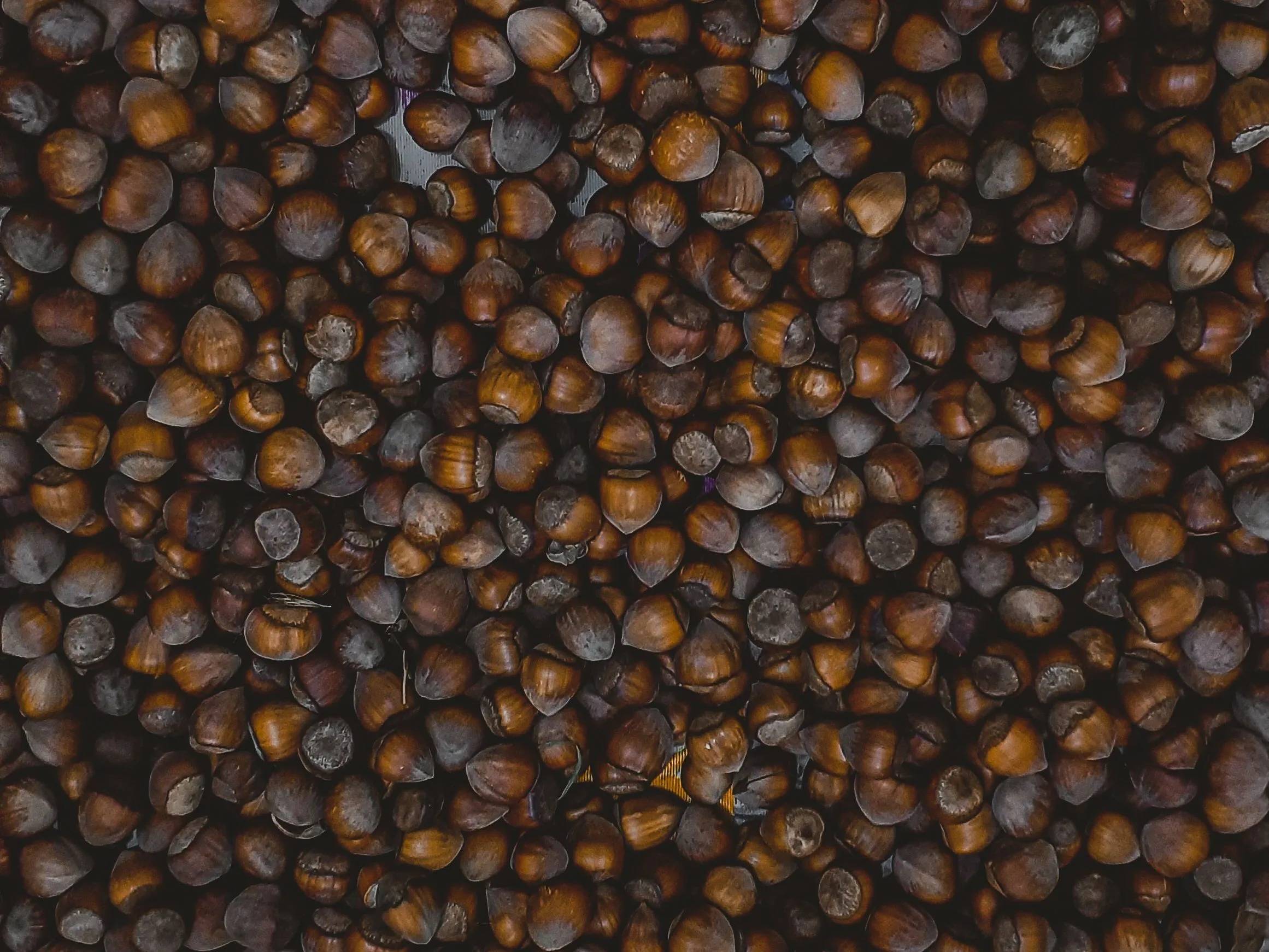
Preparing your hazelnut crop for sale: harvesting, drying, cleaning and storage
A guide for growers: how harvesting, drying, cleaning and storage preserve hazelnut quality until delivery to the buyer.
Hazelnut quality is not created in the processing plant but in the orchard and in the first few weeks after harvest. Processing can grade, clean, roast and grind hazelnuts, but it cannot undo mould, rancidity or the musty taste left by poor drying. That is why, for a grower, the most rewarding work is what happens between shaking the tree and handing over the crop.
Hasel buys hazelnuts only, all year round; we do not buy other nuts. In this guide we summarise the general rules of good practice that protect crop quality; the specific purchasing terms are agreed on request.
Harvesting: on time and from clean ground
A ripe hazelnut drops out of its husk and falls to the ground, in our region usually from late August through September, depending on variety and season. The ground beneath the canopy should be prepared before harvest: mown, levelled and cleared of branches and stones, so that the nuts are easy to collect, by hand or by machine, and as little debris as possible ends up in the crop.
The most important rule is not to leave hazelnuts lying on the ground for long. On damp ground, especially after rain and dew, the shell absorbs moisture, the risk of mould rises, and the kernel can develop dark spots and off-flavours. Frequent collection in smaller lots almost always yields a better crop than a single pick-up at the end of the season.
Drying: slowly and evenly
Freshly harvested hazelnuts contain too much moisture for safe storage and should be dried as soon as possible, ideally the same day. For natural drying, the nuts are spread in a thin layer in an airy, covered place and turned regularly, protected from rain, night dew and animals. In a dryer, the usual recommendation is to keep the air temperature at no more than around 40 to 45 °C: too high a temperature accelerates fat oxidation, alters the flavour and can damage the kernel.
Hazelnuts are dry enough when the kernel snaps rather than bends when broken and the skin comes away from the kernel easily. As a guide, well-dried in-shell hazelnuts usually have a moisture content of around 10 % or less, and kernels lower still; the exact value is best measured with a moisture meter. Nuts that are too moist heat up and go mouldy in storage, while over-dried nuts lose weight for no benefit.
Cleaning and sorting
Before delivery, the crop should be cleaned of husk residues, leaves, soil, small stones and twigs. Foreign matter not only lowers the value of the lot, it also holds moisture and spreads mould to healthy nuts. It is equally important to remove blank and undeveloped nuts, pest-damaged nuts and those with visible mould or dark stains on the shell.
Good practice is not to mix crops from different varieties, from plots of visibly different quality or from different harvest years. A uniform lot is easier to assess, grade and process. Organic crops must be kept separate from conventional ones at all times and delivered with the grower’s valid certificate.
Kernel yield: what determines the value of the crop
Kernel yield is the share of sound kernel weight in the weight of in-shell hazelnuts. It depends mainly on variety, but also on the season, orchard management and how many blank, small and damaged nuts are in the crop; for common varieties it is usually somewhere between 40 and 50 %. For a processor, kernel yield is the key measure, because in products such as raw kernels or paste it is the kernel that is sold.
Growers can roughly check the yield themselves: take a representative sample of a few hundred grams, weigh the in-shell nuts, crack them by hand and weigh the sound kernels. A check like this sets realistic expectations before purchase discussions and shows whether any problem lies in the variety, orchard care or sorting.
Alongside yield, nut size matters. Uniform, larger nuts are easier to crack and grade and produce fewer broken kernels, whereas a mix of very small and large nuts makes machine processing harder. It therefore helps to separate out markedly small nuts during sorting and to mention this when offering your crop.
Processing can clean and roast a hazelnut, but it cannot undo what moisture and mould have done to it.
Storage until delivery
Dried and cleaned in-shell hazelnuts are stored in breathable sacks (jute or woven polypropylene) or crates, on pallets, away from walls and floor. The store should be dry, cool, dark and protected from rodents, birds and insects. Sealed plastic bags are not a good choice until the nuts are completely dry, because moisture condenses inside them.
Hazelnuts readily absorb odours, so do not store them next to fertilisers, plant protection products, fuel or strongly scented goods. Check the lot from time to time: smell, warmth in the centre of the pile and any signs of pests. The shorter the storage and the more stable the conditions, the better: the shell protects the kernel, but not indefinitely. How hazelnuts travel from delivery to the finished product is described in our article The hazelnut’s journey through processing.
Let us know the quantity, variety, harvest year and drying method by phone (+385 98 269 479) or email (info@hasel.hr); purchasing terms are agreed on request.
We only use necessary cookies that the shop needs to work. Cookie policy
We only use necessary cookies and browser storage, without which the shop does not work: your basket, login, the chosen language and remembering this notice. We do not use analytics or marketing cookies. Cookie policy